
The short answer
Amber in perfume is not one ingredient and has nothing to do with fossil amber or whales. It is an accord, usually built from labdanum, benzoin and vanilla, that smells warm, resinous, softly sweet and slightly powdery. Ambergris, Ambroxan and amberwood are different materials that share the name. In Lattafa, Asad and Teriaq Intense are the clearest ambers.
“Amber” is probably the most-used and least-explained word on a fragrance box. It turns up in pyramids for sweet gourmands, smoky tobacco scents and clean soapy freshies alike, and it gets muddled with three other materials that sound almost the same. This guide sorts out what amber actually is, what it smells like on skin, how it differs from ambergris, Ambroxan, amberwood and oud, and which Lattafa bottles put it front and centre.
What is amber in perfume?
Amber is a fantasy accord: a blend perfumers build to create a particular warm, glowing effect. Fragrantica’s note page describes it as “a sweet, resinous, cozy and warm, often rather powdery note recreated from a mix of balsams”, made from “usually labdanum, benzoin, vanilla, styrax and fir or a combination of some of these”. The natural perfumer Adam Gottschalk, writing for Fragrantica, put it more bluntly: “The smell we know as amber is entirely fictional.” It is not distilled from fossilised tree resin, the golden stone used in jewellery.
The three building blocks do different jobs:
- Labdanum (also listed as cistus or rock rose) is a sticky resin from a Mediterranean shrub. It gives depth: dark, leathery, faintly animalic.
- Benzoin is a tree balsam that smells sweet, soft and a little like vanilla custard with a powdery edge.
- Vanilla (or tonka bean in some versions) rounds everything off and makes the accord feel cosy rather than churchy.
You will also see the older term “oriental” used for the same warm family. Many fragrance houses and retailers now say “amber” instead, and our Lattafa amber and oriental perfumes collection uses both words for that reason.
What does amber smell like?
Think of warm resin softening near a fire, with a spoonful of vanilla sugar stirred in. Good amber reads golden, enveloping and slightly dusty-powdery, sweet without being sugary and rich without being smoky. Because it is made mainly from heavy base materials, you rarely smell it at the first spray. It surfaces an hour or two in and then carries the rest of the wear.
How it comes across depends on the balance. A labdanum-heavy amber smells darker and more leathery; a benzoin-and-vanilla amber smells softer and closer to a dessert. Add spice and you get the classic Arabian warmth; add tobacco or incense and it turns smoky. That flexibility is why amber sits underneath so many Lattafa bestsellers, from tobacco scents to gourmands. If you want to browse every note family in one place, our Lattafa perfumes by note page groups the range that way.
Amber vs ambergris vs Ambroxan vs amberwood
These four words cause more confusion than any other group of notes. Here they are side by side.
| Name | What it is | Smells like | Lattafa example |
|---|---|---|---|
| Amber | An accord of resins and balsams (labdanum, benzoin, vanilla) | Warm, sweet, resinous, powdery | Asad, Teriaq Intense |
| Ambergris | Originally a sperm-whale secretion; today almost always recreated with synthetics | Salty, marine, skin-like, softly sweet | Atlas (listed note) |
| Ambroxan | A synthetic ambergris-type molecule made from a clary sage derivative | Dry, clean, musky, radiant | Angham Second Song |
| Amberwood | A family of synthetic woody-amber materials | Dry, woody, bright, sometimes sharp | Khamrah, Dynasty |
Amber vs ambergris
The names come from the same root, and centuries of merchants used them loosely, but they are opposites in character. Amber is a warm, sweet, plant-based accord. Ambergris began as a waxy material produced in the gut of sperm whales and found floating at sea or washed up on beaches; Fragrantica describes its effect as “skin-like salty and warm” and notes it is “synthetically recreated today”. Gottschalk’s verdict in the comments of his Fragrantica article is hard to improve on: ambergris is “definitely not the same as amber, not even close”.
The easiest way to feel the difference is to compare two Lattafas. Lattafa Asad lists amber, benzoin and labdanum in its base and dries down sweet and resinous. Lattafa Atlas lists ambergris alongside salt and sea notes and dries down mineral and skin-like. Same root word, entirely different smell. When a Lattafa pyramid says “ambergris”, treat it as a listed note describing that salty effect; the brand does not say whether any natural material is used, and modern perfumery relies overwhelmingly on synthetics. We go into the whale story, Ambroxan and the best salty bottles in our companion guide, what ambergris smells like in perfume .
Amber vs amberwood
This is the one most guides skip, and it matters for Lattafa shoppers because “amberwood” appears in a lot of pyramids. Amberwood is not a softer amber. It is a group of modern synthetic woody-amber materials, related to molecules such as Cetalox, which a Fragrantica raw-materials article describes as drier and more woody than Ambrox. Reviewing Ajmal’s Amber Wood, Fragrantica’s critic summed the category up as “more wood than amber”. On skin it reads dry, radiant and long-lasting, and in large doses some wearers find it sharp or scratchy.
So a bottle with amberwood in the base will not give you the syrupy, resinous glow of a labdanum-and-benzoin amber. Lattafa Khamrah lists amberwood next to vanilla, tonka and benzoin, so the woody-amber note adds lift under a sweet gourmand. Lattafa Dynasty (£18.99 at the time of writing) pairs amberwood with cedar and cashmeran under rooibos tea and suede, and the result is dry, polished and not sweet at all.
Where Ambroxan fits
Ambroxan is the bridge between the two families. It is a synthetic material developed to reproduce a key part of ambergris’s smell, and Fragrantica’s note page describes it as “a modern synthetic compound with a dry amber musky smell”. It is airier and cleaner than a resinous amber accord. The companion ambergris guide covers it in depth.
Amber vs oud
Amber and oud are the two pillars of Arabian perfumery, and they often appear together, but they pull in opposite directions. Amber is sweet, round and resinous; oud (agarwood) is woody, smoky, sometimes medicinal or leathery. Amber softens and warms; oud adds darkness and grip.
You can smell both at once in Lattafa Qaed Al Fursan (£11.99 at the time of writing), whose Fragrantica base is cedar, amber and agarwood beneath a smoky pineapple and saffron opening. If it is the woody, darker side you want, the Lattafa oud collection is the place to start; if you want warmth and sweetness without the wood, stay with the amber picks below.
Lattafa perfumes where amber leads
Every pick below lists amber, labdanum or benzoin in its pyramid on Fragrantica, and every one is in stock at the time of writing. They are ordered from the most amber-forward to those where amber plays a supporting role.
1. Lattafa Asad: the full resinous amber
Base on Fragrantica: vanilla, amber, dry wood, benzoin, labdanum (over black pepper, tobacco, pineapple, coffee, patchouli and iris).
Asad contains all three classic amber building blocks, and Fragrantica voters rank “amber” as its top accord. The opening is peppery tobacco; the dry-down is the textbook golden, resinous amber this article describes. Wearers quoted on our product page report roughly six to ten hours. It is the bottle to try if you want to learn what amber smells like. More detail in the Asad collection comparison.
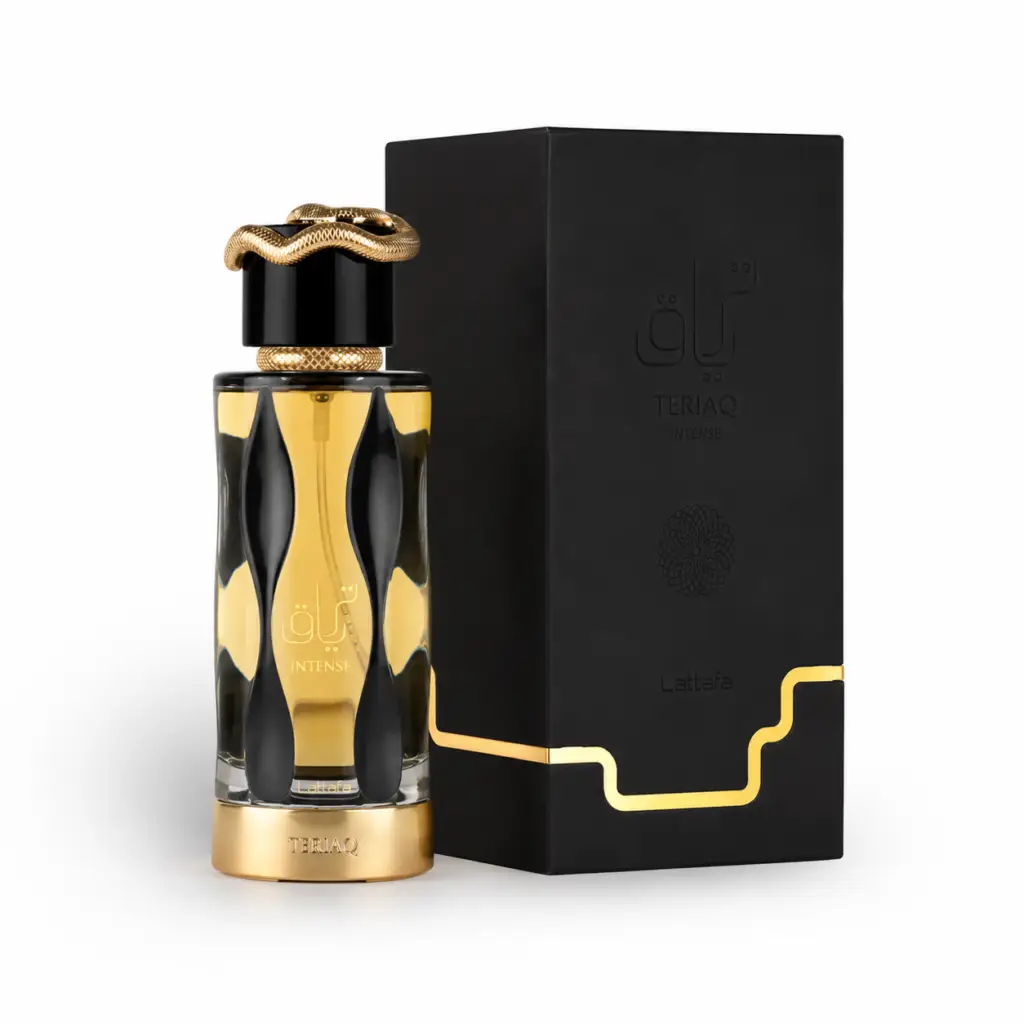
2. Lattafa Teriaq Intense: amber with boozy plum
Base on Fragrantica: amber, tonka bean, benzoin (under saffron, bergamot, plum liquor and cinnamon).
Here amber and benzoin make a sweet, balsamic cushion for a dark spiced plum-liqueur accord. “Amber” again tops Fragrantica’s accord list. It is loud, sweet and best on cold evenings; reviewers commonly report eight hours or more. Our Teriaq Intense review covers who it suits.
3. Lattafa Khamrah Dukhan: smoky labdanum amber
Pyramid on Fragrantica: labdanum and incense in the heart; amber, benzoin, tonka, tobacco and praline in the base.
Dukhan is the darker, smokier route. Labdanum and incense give the leathery, resinous side of amber, then tobacco and praline sweeten it. Wearers on Fragrantica, as summarised on our product page, report eight to twelve hours. Read the full Khamrah Dukhan review for the smoke question.
4. Lattafa Angham: amber under lavender and cocoa
Base on Fragrantica: vanilla, amber, musk (under lavender, cacao, praline and jasmine).
Amber is a supporting player here, warming a lavender-vanilla gourmand from underneath. It shows how a little amber makes a sweet scent feel fuller and more grown-up. A good choice if pure resin sounds too heavy.
5. Lattafa Asad Zanzibar Limited Edition: a light amber landing
Base on Fragrantica: amber, sandalwood, cedar, tonka bean (under marine notes, lavender, soap and cashmeran).
The freshest bottle on this list. It opens clean and soapy, and the amber only arrives in the last stretch as a soft warm finish. Pick it if you want a touch of amber you can wear in spring and summer.
Shop Asad Zanzibar Limited Edition – £17.99
Prices are at the time of writing. Delivery is free on every UK order, with no minimum spend.
Does amber perfume last long?
Generally, yes, and the reason is structural. Labdanum, benzoin and vanilla are heavy, slow-evaporating base materials, so an amber accord is usually the last thing still on your skin at the end of the day and clings to wool and cotton even longer. How long a specific bottle lasts depends on its concentration, the other notes and your skin, so check wearer-reported figures for the fragrance itself rather than assuming.
Wearing amber in UK weather: amber blooms in cold, damp air, which makes it a natural choice from October to March. In a warm office or on a hot July day it can feel heavy, so use one or two sprays, or reach for a lighter amber such as Zanzibar Limited Edition. Spraying on a scarf rather than bare skin softens the sweetness and stretches the wear.
Amber in perfume: FAQs
Quick answers to the questions UK shoppers ask most.
Is amber the same as ambergris?
No. Amber is a warm, sweet accord built from plant resins and balsams such as labdanum, benzoin and vanilla. Ambergris originally came from sperm whales and smells salty, marine and skin-like; in modern perfumery its effect is recreated with synthetic materials such as Ambroxan. The names share a root, which is why they get confused, but the smells are very different.
Is amber perfume made from real amber stone?
No. Standard perfume amber is not distilled from fossilised tree resin. It is an accord a perfumer builds from materials such as labdanum, benzoin, vanilla and styrax to create a warm, glowing effect. A Fragrantica raw-materials article calls the smell “entirely fictional”, meaning it is constructed rather than extracted from a single source.
What is the difference between amber and vanilla?
Vanilla is one ingredient: sweet, creamy and edible. Amber is a blend that often contains vanilla but adds resins such as labdanum and benzoin, so it smells deeper, more resinous and slightly powdery. If a vanilla scent feels too dessert-like for you, an amber usually feels warmer and more adult. Our guide to the best Lattafa vanilla perfumes covers the sweeter end.
Is amber a masculine or feminine note?
Neither. Amber is used across men’s, women’s and unisex fragrances. What changes the impression is what surrounds it: pepper and tobacco, as in Asad, push it masculine, while lavender and cocoa, as in Angham, make it softer. Most amber-led Lattafas are worn comfortably by anyone who likes warm, sweet scents.
Is amber the same as amberwood?
No. Amberwood describes synthetic woody-amber materials that smell dry, bright and woody rather than sweet and resinous. Fragrantica describes this style as “more wood than amber”. If you see amberwood in a pyramid, expect radiance and lift, not the golden, syrupy glow of a labdanum and benzoin amber.
Does amber perfume last long?
Usually, because the materials in an amber accord are heavy base notes that evaporate slowly. Amber is often the last part of a fragrance you can still smell, and it lasts longer again on clothing. Exact performance depends on the bottle and your skin, so check wearer-reported figures for the specific fragrance before buying.
When should I wear amber in the UK?
Autumn and winter suit amber best, because cold air keeps its sweetness in check and lets the resin glow. Evenings, dinners and weekends are its natural home. In summer or a warm office, use one spray, apply to clothing, or choose a lighter amber with fresh notes on top, such as Asad Zanzibar Limited Edition.
Written by Shaheen Shah Abrar, Founder of Royal Scents. Notes checked against Fragrantica and lattafa.com.
References
- Fragrantica: Amber note page
- Fragrantica: What Is Amber Anyway? (Adam Gottschalk)
- Fragrantica: Ambergris note page
- Fragrantica: Ambroxan note page
- Fragrantica: Ambergris, Ambrox and Ambroxan of the Year (Matvey Yudov, 2022)
- Fragrantica: Three Ambers from Ajmal (Igor Masyukov, 2023)
- Lattafa Asad on Fragrantica
- Lattafa Teriaq Intense on Fragrantica
- Lattafa Khamrah Dukhan on Fragrantica
- Lattafa Angham on Fragrantica
- Lattafa Asad Zanzibar Limited Edition on Fragrantica
- Lattafa Khamrah on Fragrantica
- Lattafa Dynasty on Fragrantica
- Lattafa Qaed Al Fursan on Fragrantica
- Lattafa Atlas on Fragrantica