
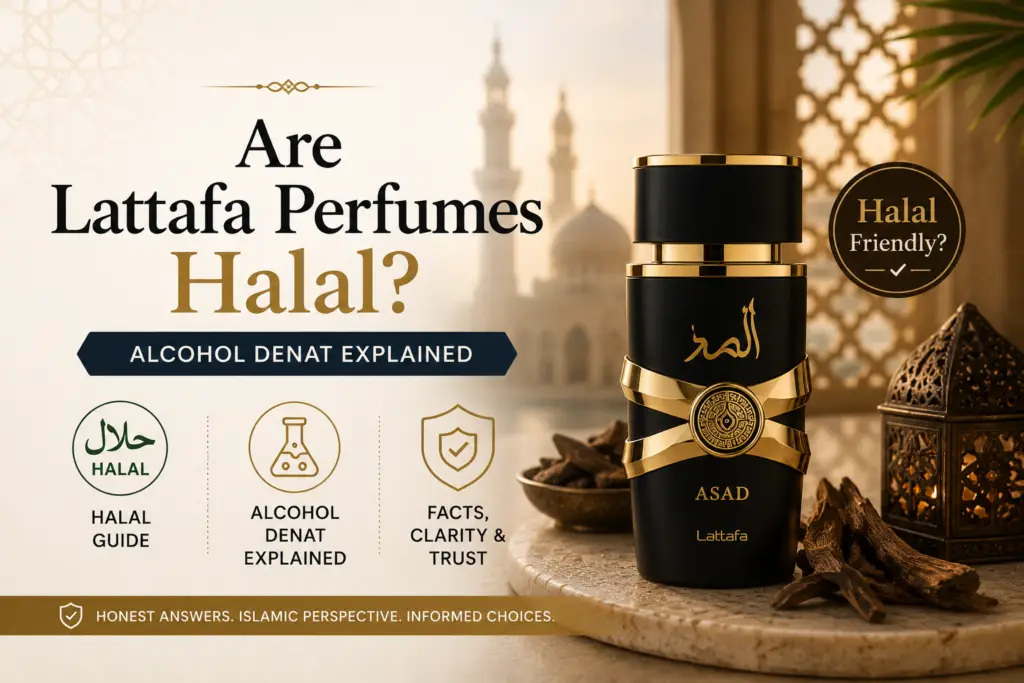
It is one of the most common questions UK Muslim buyers ask before reaching for a Lattafa: is an alcohol-based perfume halal to wear? The honest answer is that it depends on a genuine difference of opinion among scholars — and on what kind of alcohol is actually in the bottle.
Shop the bottles in this guide


100% authentic Lattafa · Free tracked UK delivery · Dispatched within 24 hours · 30-day returns
This guide explains what “alcohol denat” is, how scholars distinguish it from khamr, and the main views on wearing it. It also lays out your alcohol-free options and how to gift thoughtfully for Eid.
Important: Royal Scents is a fragrance retailer, not a religious authority. This page is educational and presents scholarly views neutrally. It does not issue a fatwa. For a ruling that applies to you personally, please consult a qualified scholar or your local imam.
1. What “Halal Fragrance” Really Means
Here is something most retailers won’t tell you: perfume is not usually “halal certified.” Unlike food, fragrances and cosmetics generally fall outside routine halal certification schemes.
So when shoppers search for “halal perfume,” they usually mean a scent free of doubtful ingredients and suitable to wear, including for prayer. In practice that comes down to three things: the ingredients, the source of the alcohol, and your own scholarly position.
That means a “halal fragrance” is less a label you can buy and more a decision you make — ideally informed by knowledge and the guidance of someone qualified to give it.
2. Alcohol Denat vs Khamr: The Key Distinction
“Alcohol denat” — short for denatured alcohol — is ethanol that has had additives mixed in to make it undrinkable. In perfume it works as a solvent: it carries the fragrance oils, helps the spray mist evenly, and helps the scent project and last.
This is the distinction many scholars focus on. Khamr, the intoxicating drink prohibited in Islam, was classically described as coming from grapes and dates. The synthetic, non-consumable alcohol in modern perfumery is chemically and functionally a different thing — a solvent, not a beverage.
| Khamr (intoxicating drink) | Alcohol denat (in perfume) | |
|---|---|---|
| Purpose | To be consumed and intoxicate | A solvent to carry fragrance |
| Classic source | Grapes and dates | Usually synthetic / grain / other |
| Drinkable? | Yes | No — denatured to be undrinkable |
| Used how | Internally | Externally, on skin/clothes |
This difference is exactly why scholars reach different conclusions — and why the answer is not a simple yes or no.
3. The Main Scholarly Views (Presented Neutrally)
There is a real, longstanding difference of opinion here. We present the two broad positions so you can recognise them — not to choose for you.
The widely-held permissive view. Many contemporary scholars and fatwa bodies hold that perfume made with synthetic or non-grape/date alcohol is pure (tahir) and permissible to use externally. They lean on the juristic principle that the default state of things is purity, and that something being forbidden to consume does not automatically make it impure to touch. On this view, wearing such perfume does not invalidate prayer.
The cautious view. Some scholars consider intoxicating alcohol impure regardless of source, or simply recommend avoiding alcohol-based scent during salah out of caution. Others advise that where label details are unclear, choosing alcohol-free oils removes any doubt entirely.
Both positions come from serious scholarship. Which one applies to you is a question for a scholar who knows your situation and the school of thought you follow.
4. What This Means for Lattafa
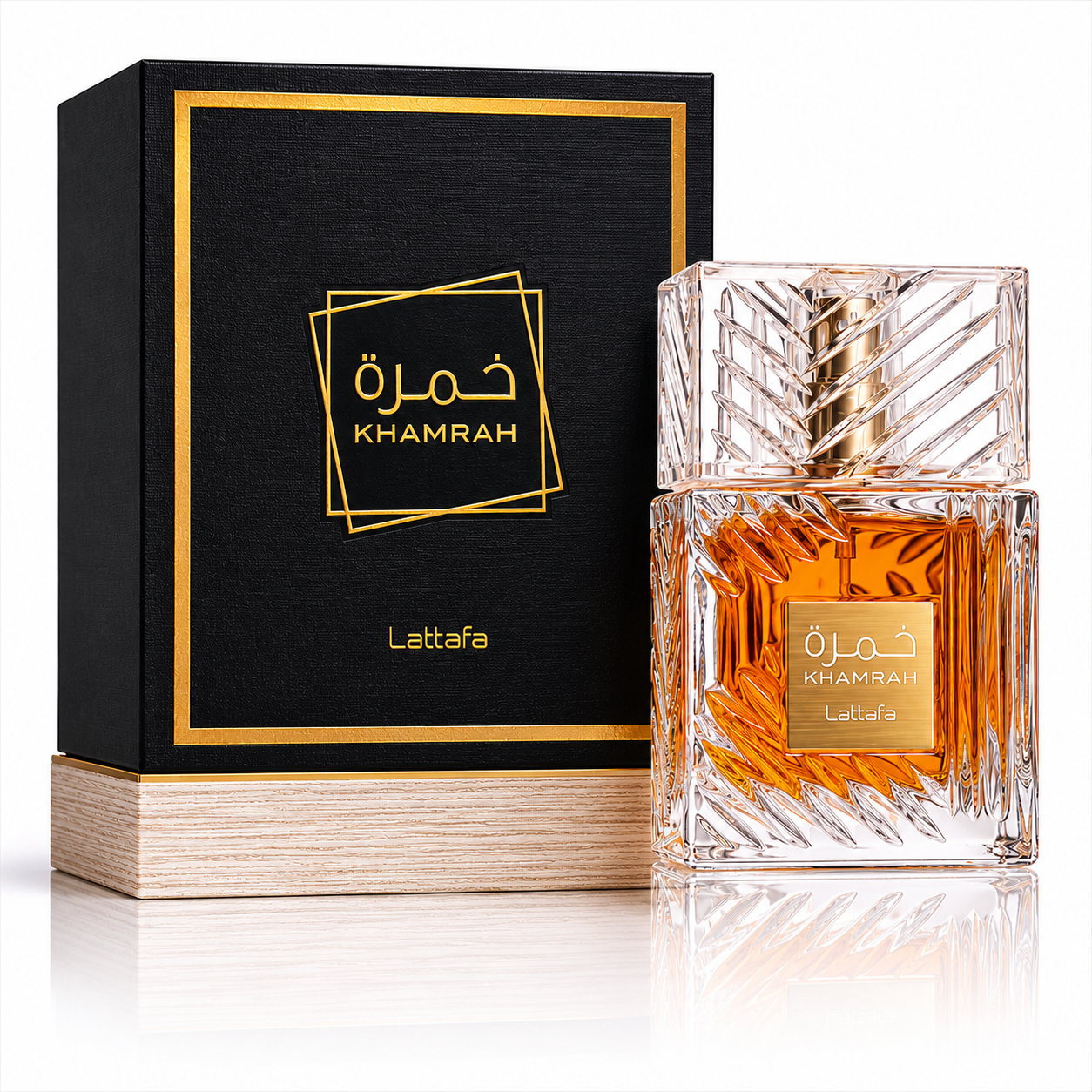
Let’s be straight about the product. Most mainstream Lattafa eau de parfums — including popular sellers like Asad, Khamrah and Yara — are built on a denatured alcohol base, as is typical across modern Arabian-style perfumery.
So a Lattafa EDP is not an “alcohol-free” product, and we won’t pretend otherwise. Whether it is suitable for you depends on which of the views above you follow.
If you hold the permissive view, these fragrances are used the same way as any other perfume. If you prefer to avoid alcohol entirely, an eau de parfum is not your category — and that is what the next section is for.
5. Alcohol-Free Alternatives (Attars and Oils)
For anyone who wants to sidestep the alcohol question completely, oil-based fragrance is the traditional answer. Attars and perfume oils carry scent in a non-alcohol base, so the debate simply does not arise.
They wear differently from a spray: closer to the skin, more intimate, and often longer-lasting in their own way, applied to pulse points rather than misted over clothing. Many people who pray regularly keep an oil specifically for that reason.
If alcohol-free is your priority, look for products explicitly labelled as oil-based, attar, or alcohol-free rather than eau de parfum. Contact us if you’d like help identifying suitable options.
6. Wearing Scent Around Others
One point nearly everyone agrees on, separate from the alcohol debate: fragrance worn around others should be moderate. A scent that is pleasant and considerate is welcome; one that overwhelms a room is not.
This matters most in shared spaces like the mosque, where a heavy, projecting fragrance can distract people at prayer. The practical advice is simple — apply lightly, favour a moderate sillage, and keep the experience pleasant for those nearby.
If you’re choosing a scent specifically for the mosque or gatherings, a restrained application of a clean, warm fragrance is the considerate choice, whichever view on alcohol you hold.
7. Eid Gifting
Fragrance is one of the most loved gifts in Muslim culture, and Eid is its peak moment. A well-chosen scent says thought and generosity without breaking the bank.
When gifting, consider the recipient’s own preference on alcohol — if you know they keep strictly to alcohol-free, an attar or oil is the safe and thoughtful pick. If not, a beautifully presented EDP from a much-loved house makes a generous gift at an accessible price.
For curated picks by budget and occasion, see our dedicated Lattafa Eid gifts guide.
8. Frequently Asked Questions
Are Lattafa perfumes halal?
Most are alcohol-denat EDPs, so there’s no single answer. Many scholars permit such perfume externally; some are cautious. Ask your own scholar for a personal ruling.
What is alcohol denat?
Ethanol made undrinkable with additives, used as a solvent to carry fragrance oils.
Is alcohol denat the same as khamr?
Many scholars distinguish them — khamr is intoxicating drink, denat is a non-consumable solvent — though views differ.
Does alcohol-based perfume break wudu?
According to most scholars, applying perfume does not invalidate wudu. Specific actions break wudu; fragrance is not one of them.
Can I pray while wearing alcohol-based perfume?
On the common view that it is pure, yes. Some scholars prefer avoiding it during salah out of caution. Follow your own guidance.
Is Lattafa halal certified?
Perfume generally isn’t certified; certification mainly covers food. Suitability comes down to ingredients and your scholarly position.
What source is Lattafa’s alcohol from?
Modern Arabian-style perfumery typically uses synthetic or non-grape/date denatured alcohol, which is central to the permissive view.
Which Lattafa products are alcohol-free?
The popular EDPs are alcohol-based. For strictly alcohol-free, look to oil-based attars rather than eau de parfum.
Are attars better for prayer?
Many who pray regularly prefer oils because they avoid the alcohol question entirely and sit close to the skin.
Is a small amount of alcohol acceptable?
Some scholars note that a very low alcohol percentage is treated leniently. This is a point of scholarly detail — ask a qualified scholar.
Why do scholars disagree on this?
Because they weigh the source of the alcohol, whether it counts as khamr, and the principle of default purity differently.
Is it haram to sell alcohol-based perfume?
That too is a scholarly question beyond our scope. We focus on giving you accurate information to decide with guidance.
Can women wear Lattafa to the mosque?
The shared etiquette is moderation and not overpowering others. Specific guidance varies — consult your scholar.
What’s a good alcohol-free Eid gift?
A quality attar or perfume oil, nicely presented, is a thoughtful alcohol-free choice.
Does Royal Scents give religious rulings?
No. We provide honest product and ingredient information; rulings come from qualified scholars.
About the Author
Shaheen Shah Abrar is the Founder of Royal Scents (Fragrancy Limited, London) — the UK’s most comprehensive Lattafa fragrance retailer specialising in designer alternatives and Arabian perfumery.
Shaheen built Royal Scents to bring authentic, research-verified Lattafa fragrances to UK buyers. Every product description and hub page is personally researched against multiple expert sources — Parfumo, ScentClones, Equivalenza Profumi, Fragrantica, and Skinsort. The mission: cut through designer dupe marketing hype and deliver honest information UK buyers can actually trust.
Related Guides & Categories
Best Lattafa Eid gifts (UK) · How to spot fake Lattafa · Lattafa oud perfumes · Lattafa for men · Lattafa for women · Unisex Lattafa